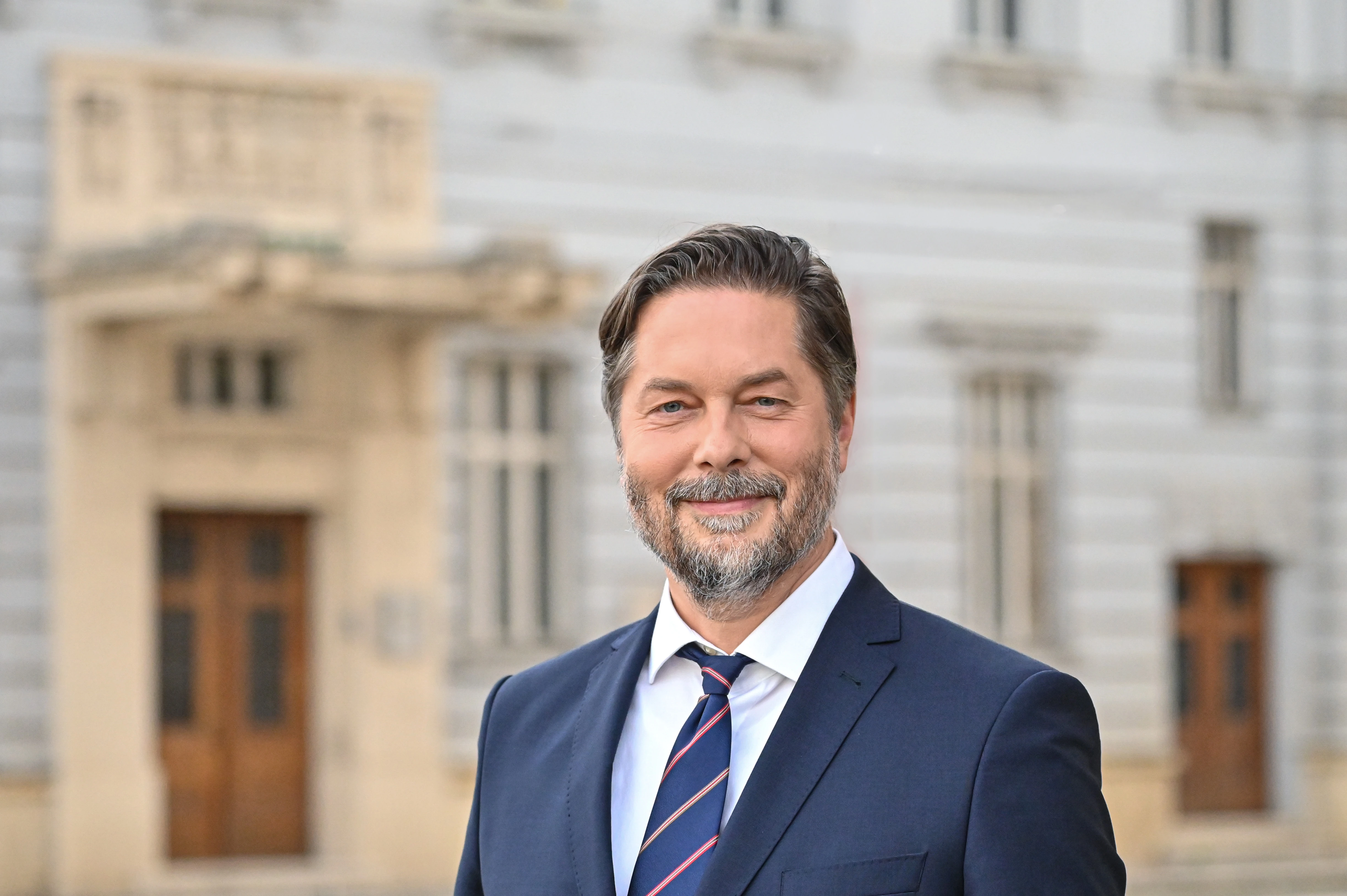
Institutions do not necessarily change only through revolution or path-dependent adaptation. According to Professor Jozef Bátora, there is also a third, less visible course of change that no one deliberately directs – institutional repositioning or reconfiguration. The same question of how and why established arrangements change now also guides his research into the development of European diplomacy and defence.
Jozef Bátora is a professor at the Department of Political Science at Comenius University’s Faculty of Arts and at the Department of International Relations at Webster Vienna Private University. His research revolves around a long-standing question: How do political institutions change?
Professor Bátora notes that institutions are social structures that most people take for granted and that therefore act as stabilising forces in society. In politics, these include not only domestic institutions such as political parties, constitutional courts, and parliaments, but also international institutions such as diplomacy, war, sovereignty, and territoriality.
Scholars have traditionally identified two basic ways in which institutions change. They either adapt gradually to their environment along paths shaped by previous developments, or they change abruptly and radically in moments of revolution. Professor Bátora’s research shows that alongside these two pathways, there is a third, less explored course of change. It occurs less visibly, when organisational structures, practices, and language from previously separate societal domains begin to combine in interstitial spaces. He calls this change “institutional repositioning” or institutional reconfiguration. As he describes it, it is a process in which a series of smaller recombinations gradually leads to fundamental change.
In 2025, for example, he studied this process in the transformation of warfare under the influence of private military and security companies, whose communication increasingly blends military terminology with the language of other societal domains, such as technology, logistics, and energy. He previously identified a similar type of transformation in 2013 in connection with the establishment of the European External Action Service, the European Union’s diplomatic service. He was the first to conceptualise the EEAS as an interstitial organisation spanning the domains of foreign affairs, defence, development cooperation, and intelligence. The concept has since become established and is referred to in some international academic literature on the evolution of European diplomacy and the EU as a political entity.
Professor Bátora’s interest in institutions grew out of a family environment in which politics and history were often discussed, and particularly out of a year he spent as a secondary-school student in West Berlin during the pivotal 1991–1992 school year, as he was living through a period of profound change in Europe. He completed his bachelor’s degree at the Department of Political Science, Faculty of Arts, Comenius University, while the department was still headed by dissident and professor Miroslav Kusý. He then studied public administration at the University of Bergen in Norway and earned his PhD in political science at the University of Oslo. There, he worked with Johan P. Olsen, one of the founders of what became known as the new institutionalism. He spent a year at Stanford University during his doctoral studies, where he studied under leading institutional scholars including James G. March and Walter W. Powell. He was later offered a research position at ARENA Centre for European Studies at the University of Oslo – the kind of opportunity many academics can only dream of. In the end, however, he stayed only briefly. Together with his wife Zuzana, who wanted to return home after many years abroad, he moved to Bratislava.
Professor Bátora says that the Slovak academia lags behind its Western counterparts in many respects, but he also values the room it gives him to take initiative and to build institutions and practices that did not previously exist here. World-class science and research done in Slovakia is now showing itself to the world in articles that he and his colleagues at the Department of Political Science regularly publish in leading international academic journals and with major academic publishers, as well as in international research projects with their active participation.
The same interest in transformation and emerging institutional arrangements now informs a four-year project on a particularly pressing issue – new forms of European defence. He is examining whether the European Union will grow into a defence actor in its own right, an actor with overlapping sources of public, private, and civil authority, or whether defence in Europe will be fragmented among individual states and regional groupings.
When Jozef Bátora is not doing research, he enjoys travelling and sport, particularly running and cycling. When visiting new places, he prefers to explore on foot and talk to locals. He considers this to be the best way of learning about the world. He also spends a great deal of time with his wife and their two sons, Adam and Michal, with whom he enjoys long conversations.