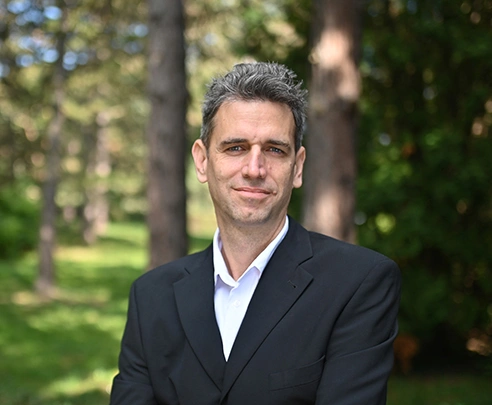
Professor Martin Kahanec is one of Europe’s leading experts on labour markets, migration, and social inequalities. As an economist, he has long studied how labour markets evolve under the influence of globalization, technological innovation, and workforce mobility. His research has a strong societal dimension, showing how public policies can be designed to support an efficient economy, empower vulnerable groups, and strengthen social cohesion.
He focuses particularly on migration. At a time when this topic is often the subject of political controversy, he brings data and facts. His research demonstrates that labour mobility contributes to productivity growth and economic resilience, especially during times of crisis. “Migration and mobility are not a threat, but an opportunity. If properly managed, they strengthen both society and the economy,” he emphasizes.
Kahanec also addresses inequality and the quality of working conditions. Together with his team, he developed a methodology for calculating a living wage, which is now used worldwide - from the European Commission and the United Nations to major employers and social partners. He sees the living wage not just as an economic indicator, but as a key tool for ensuring dignified living conditions and unlocking people’s potential and talents.
A major part of his mission is institution-building. Together with his wife, he founded and leads the Central European Labour Studies Institute (CELSI) in Bratislava - an independent research institute that provides data and analysis on labour markets and social policy. He also serves as a professor at Central European University in Vienna and at the University of Economics in Bratislava, where he engages in research and mentors the next generation of economists.
His approach is grounded in the belief that economic research should not remain confined to academic texts. The results of his work directly influence policies that affect the lives of millions. “I see great value in science when it can improve people’s everyday lives and contribute to a fairer society,” he says.
In addition to his scientific and teaching work, he is active in science communication. He frequently appears in media and public discussions, where he explains complex topics - such as migration, inequality, and the impact of technology on the labour market - in an accessible way. His goal is to ensure that debates on these issues are based on facts, not prejudice or myths.
Beyond research, he actively participates in international policy discussions. He has collaborated with the European Commission, the World Bank, OECD, and the European Parliament, serving as an expert in shaping employment and social policies. During the COVID-19 pandemic, he was a member of Slovakia’s crisis economic team and contributed to measures that mitigated the impact on employment and vulnerable groups.
In his free time, he enjoys music and travel. Encounters with other cultures inspire his scientific work, which combines economic analysis with a deep understanding of social processes. His work helps Slovakia and Europe face the challenges of globalization while protecting the dignity and rights of people in the labour market.