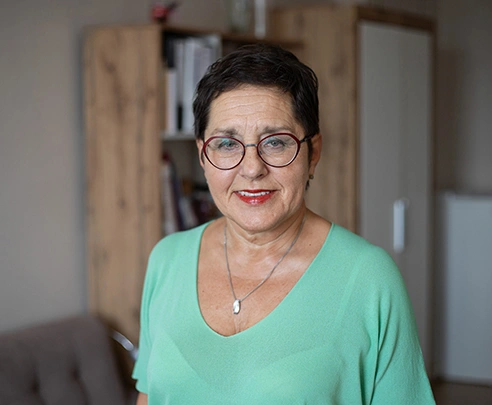
doc. PaedDr. Vladimíra Kurincová Čavojová, PhD., focuses her research on why people are influenced by social identity, cognitive biases, and conspiracy theories, and what can help us better distinguish between facts and unfounded beliefs. As a psychologist, she studies the mechanisms of thinking that determine whether we rely on evidence or fall for misinformation. “Scientific thinking is not natural for most people. We have to learn it and consciously develop it,” she says.
Her work shows that a key factor is not only education but also trust in science and institutions. She explores how these factors affect society’s resilience to misinformation, especially that which spreads through social media. “We often feel rational and resistant to manipulation, but research shows that cognitive errors affect everyone,” she explains.
In addition to cognitive psychology, she addresses practical questions: how to support scientific thinking in schools, how to teach young people to work with information, and how to strengthen trust in experts. She emphasizes that the goal is not for everyone to master all scientific disciplines, but to learn how to recognize the quality of evidence and distinguish between fact and opinion.
Kurincová Čavojová is also known for highlighting the psychological mechanisms behind belief in conspiracy theories. According to her, people often seek simple explanations in a complex world, and this opens the door to the spread of false information, including conspiracy theories and pseudoscience. “Conspiracy theories give people a sense of certainty and control, even though it’s more of an illusion. In reality, they are most often linked to feelings of threat and reduced well-being,” she warns.
The societal relevance of her research is clear. In a time when the world faces pandemics, climate crises, and geopolitical conflicts, the ability to distinguish between truth and misinformation is more important than ever. Her studies offer not only theoretical insights but also practical recommendations for education, media, and public policy makers.
Although she deals with serious topics, she is also active in science communication. She enjoys making psychology accessible to the public and explaining why our thinking isn’t always as reliable as we believe. “Each of us is prone to believing nonsense. The difference is whether we admit it and work to improve,” she adds.
In her free time, she finds balance outside the world of science. She enjoys reading, traveling, and spending time with her family and friends, who are a source of energy and inspiration. Even in her personal life, she’s fascinated by how people think and make decisions – psychology is not just her profession, but also a way to understand the world.