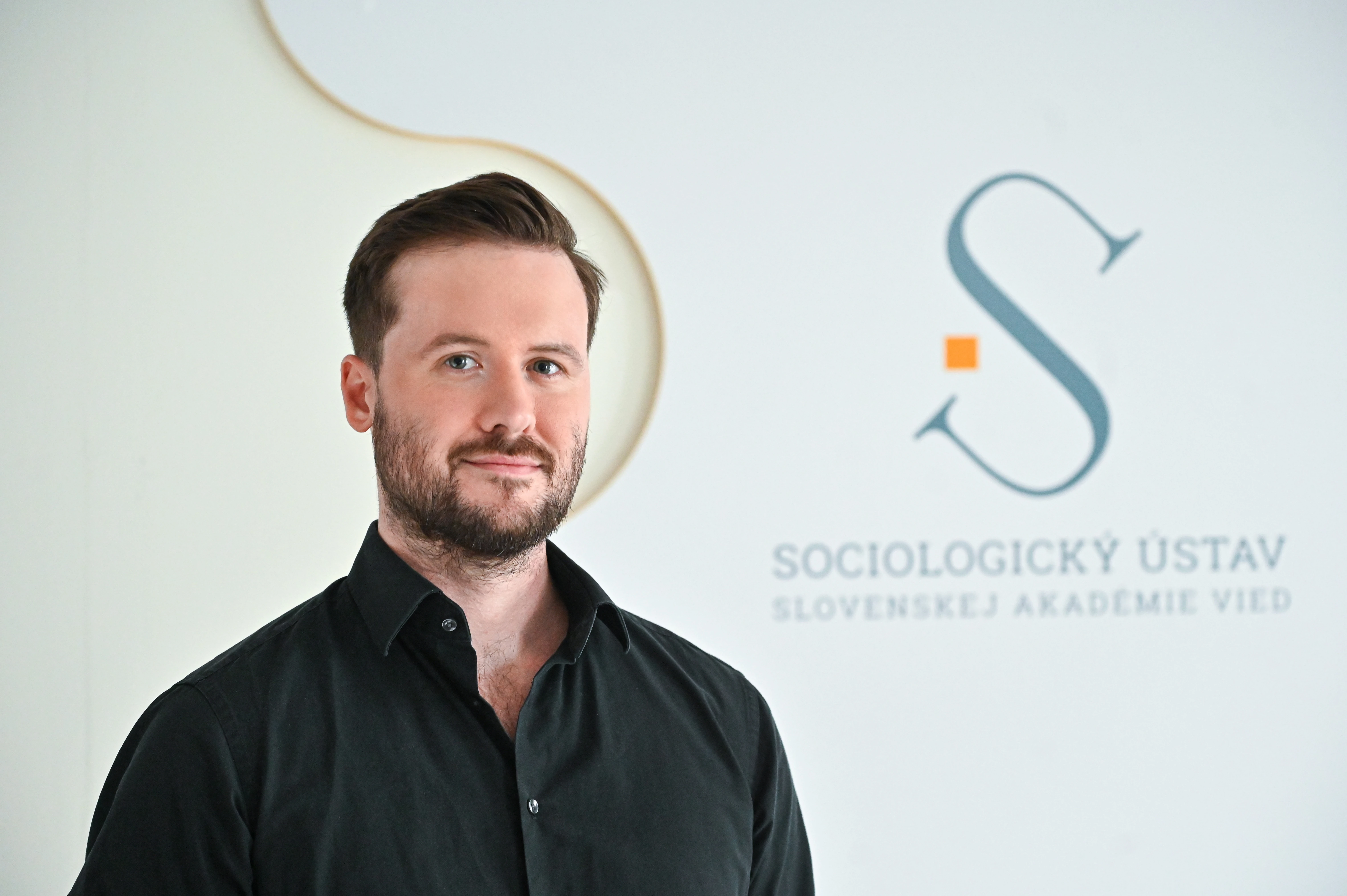
The main research interest of Dominik Želinský, PhD, from the Institute for Sociology of the Slovak Academy of Sciences, lies at the intersection of power and culture. His research explores how power works in modern society, how it presents itself, and how it becomes legitimate in the eyes of the public. He has been investigating the phenomenon of charismatic authority. In today’s fragmented political landscape, where traditional political parties are losing influence, he has examined the rise of prominent leaders who build their appeal on a belief in their own uniqueness. “They often derive their legitimacy from the conviction that they are the only ones capable of solving our problems,” the sociologist explains.
He spent a few years leading the national PanTruth (Pandemic Truth) project, in which he and his team studied tensions surrounding conspiracy theories during the COVID-19 pandemic. Rather than treating conspiracy theories as an isolated problem, he examined how the term became a weapon in clashes between different political and social groups. His research showed that the growing prominence of the issue was closely connected to increasing digitalisation, shifts in politics, and challenges to the authority of experts. “By labelling something a conspiracy, different groups in online spaces effectively define what is still acceptable within public debate and what is not,” Želinský explains.
Another arm of his research is the focus on authority in the world of modern technology. He examined how technology leaders such as Elon Musk present themselves publicly, showing how their distinctive communication styles and the construction of prophecies about the future can directly influence global economic and political developments.
He currently leads the Slovak part of CIDAPE, a major international European project funded through Horizon Europe, which focuses on the climate crisis and examines how different social groups perceive climate policies of the European Union. “The research also included in-depth interviews with workers and managers at automotive plants. We found that refusing or challenging climate measures often stems not from a lack of information or denial of climate change itself, but from the very real complications and uncertainties these policies introduce into people’s everyday working lives and livelihoods,” Želinský says.
Understanding these lived experiences and perceptions of injustice is, in his view, essential to designing socially sensitive national and European policies.
Dominik Želinský studied sociology and earned his PhD at the University of Edinburgh with a dissertation on the historical and cultural sociology of intellectual resistance to socialism. He subsequently spent two years as a postdoctoral researcher at the University of Copenhagen as part of the interdisciplinary project Who Are We. He is currently also a Faculty Fellow at the Center for Cultural Sociology at Yale University. He is a recipient of the Slovak Academy of Sciences’ Štefan Schwarz Award for young researchers as well as a UK Economic and Social Research Council (ESRC) scholarship. His research is regularly published in leading international and European academic journals, including Sociological Theory and Sociology.
One of his major personal and professional goals is to challenge the perception of Central and Eastern Europe as a scientific periphery that merely adopts knowledge produced in the West. “Our task is to analyse what is happening in our region using world-class methods and to show the international academic community that the processes taking place here are not marginal. On the contrary, they offer important insights and provide an opportunity for others to learn from our region as well,” he emphasises.
Above all, research has taught him to listen deeply and critically to what people say about themselves and about their claims to power. It has taught him to continually question things that may initially appear natural or self-evident and to uncover the hidden social structures and myths behind them, such as the myth of pure meritocracy.
In his free time, he enjoys reading both academic literature and fiction, as well as exercising and staying active as a counterbalance to mental work. Alongside his research, he is strongly committed to bringing social science to a wider audience. He regularly writes essays and opinion pieces for Slovak and Czech newspapers and has twice been nominated for the Open Society Foundation’s Journalism Award in the Best Commentary category.