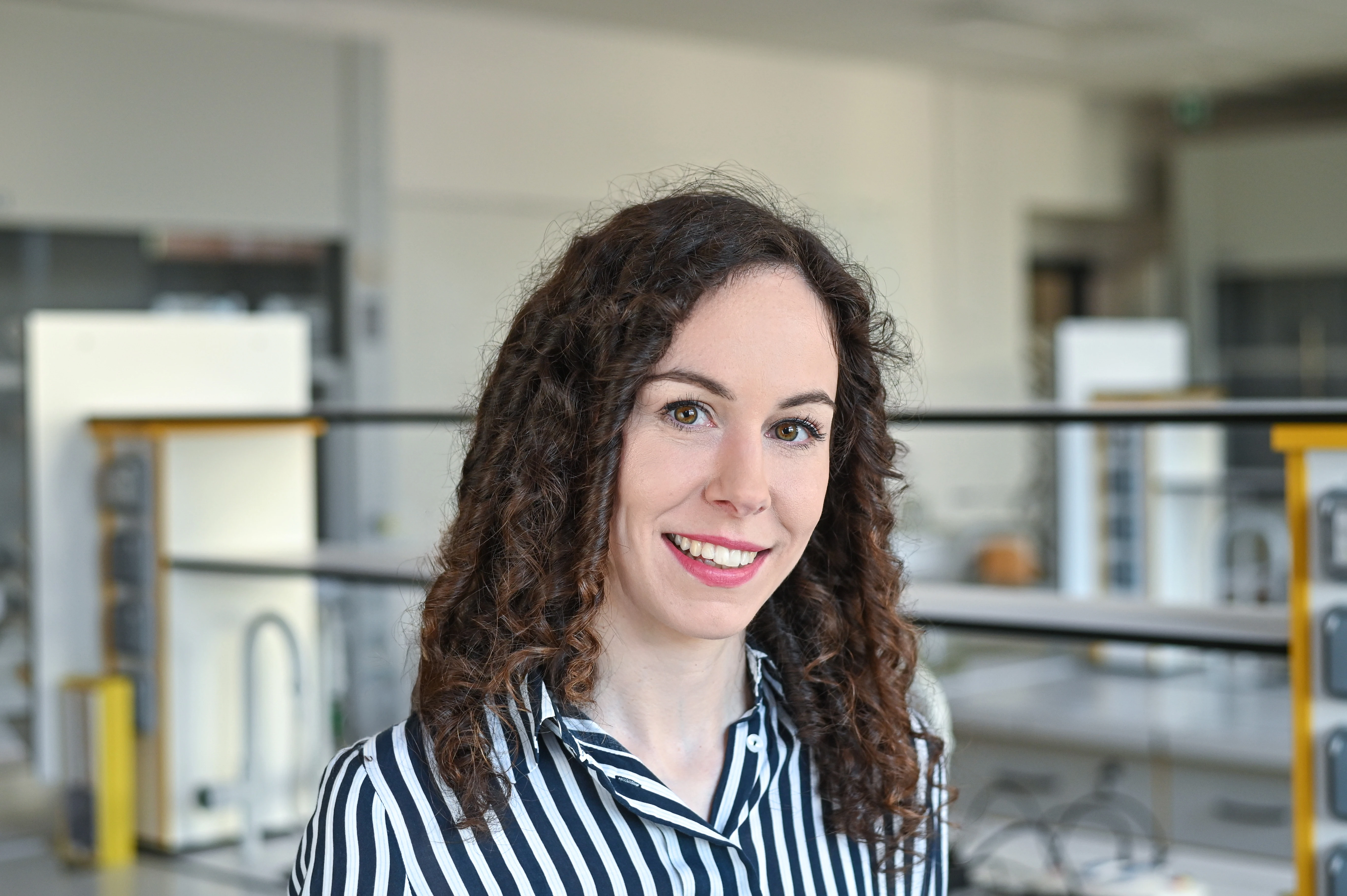
All the research of Miriama Malček Šimunková, PhD, at the Faculty of Chemical and Food Technology of the Slovak University of Technology in Bratislava, revolves around tiny particles known as reactive oxygen species and free radicals. These are highly unstable and reactive particles that naturally play a role in maintaining balance and regulating biological processes in the human body. However, when produced in excess, they trigger oxidative stress and damage key cellular components – proteins, lipids, and DNA – contributing to the development of cancer and neurodegenerative diseases.
In her work, however, the young scientist shows that this high reactivity can also be harnessed to our advantage. “We can control these particles in the body so that they are generated precisely where we need them and destroy unwanted cells – whether cancer cells or pathogens such as bacteria and viruses,” she explains.
Building on her expertise in biomedical chemistry, she has expanded her research into applied environmental chemistry, collaborating with environmental engineering experts to investigate how oxidative processes can be used to remove microplastics, pharmaceuticals, toxins, and other pollutants from water.
She also works with photosensitive metals and antimicrobial materials effective against pathogens, with considerable potential for applications in healthcare and environmental protection. In addition, she contributes to projects investigating microplastics and their potential links to the development of cancer.
Miriama Malček Šimunková’s work relies a lot on electron paramagnetic resonance (EPR). She compares this technology to magnetic resonance imaging used in medicine. While medical imaging examines protons in atomic nuclei, EPR uses electrons in atomic shells to measure changes and oxidation processes.
As major bottlenecks on research, she names not only funding but also the technological and physical limitations of scientific instruments. “One of our major research ambitions is to move from indirect detection of radicals to detecting them directly in real time. We want to simulate conditions in the human body and in nature so that we can monitor these processes under the most realistic conditions possible, rather than relying solely on theoretical models,” she explains.
This is also why, as the recipient of a prestigious international Marie Skłodowska-Curie Fellowship under Horizon Europe, she has decided to undertake a research fellowship at the Central European Institute of Technology (CEITEC) in Brno. Its unique research infrastructure will allow her to connect her work with the latest international developments, including metal-organic frameworks (MOFs) and energy research. “I consider the discovery of MOF structures a breakthrough. They open up brand new possibilities for targeted therapies, drug delivery, green energy applications, and energy storage. Our vision is to bring this cutting-edge knowledge and technology to Slovakia as well and to further develop international collaboration,” Malček Šimunková says.
What she loves most about her work is its variety and unpredictability. “In science, we get to play throughout our entire careers. We set up an experiment, make a prediction about what will happen, and suddenly something completely unexpected occurs. No two days are the same,” she says with a smile.
For her, science is one of the best tools for countering misinformation. “Many people do not realise how many years of research lie behind something as ordinary as taking a painkiller in the morning or drinking clean water right out of the tap. Science makes our lives easier every day and gives us reliable answers.” Patience and the ability to look at problems from different perspectives that she was taught by work also help her in personal life.
In her free time, she likes to unwind by enjoying cultural events, theatre, concerts, and good food, where she enjoys discovering new flavours. She spent ten years competing in ballroom dancing and still enjoys returning to it occasionally at social events.