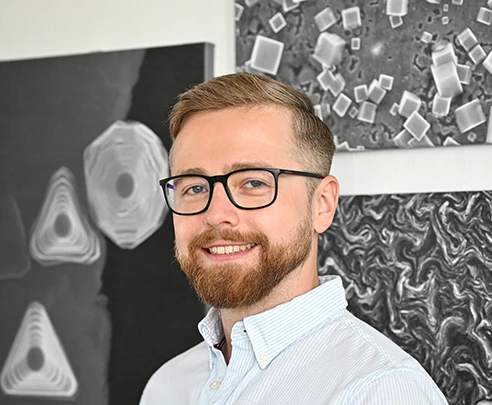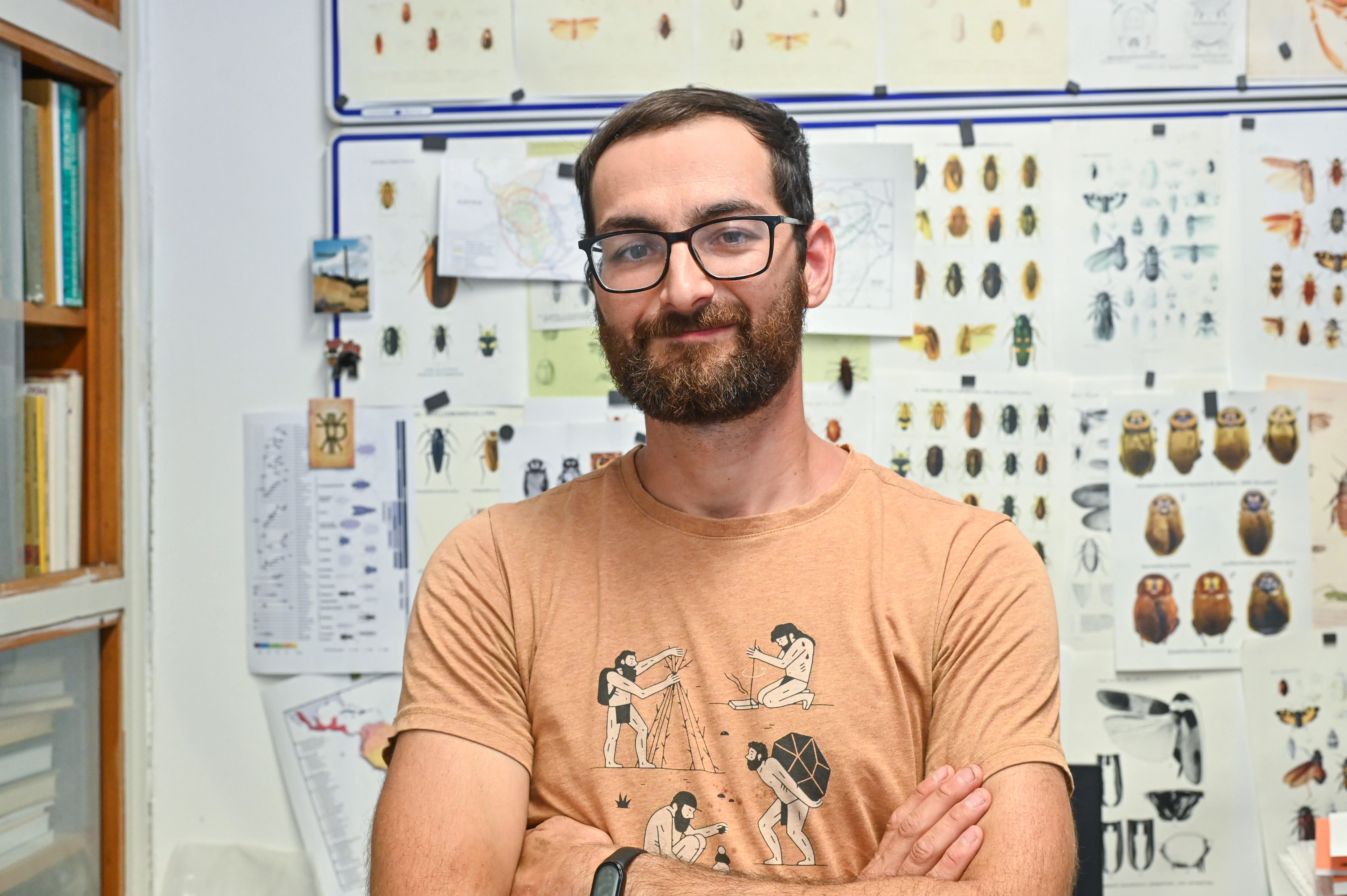
In 2016, palaeoentomologist Mgr. Hemen Sendi, PhD, brought a piece of amber back from fieldwork in Lebanon. The piece then spent a few years collecting dust in his office and nobody knew that something extraordinary was hidden inside. Only when the amber was processed by cutting it into a thin section did a tiny insect come to light. This finding in the scale of just a few millimetres ultimately became the first known evidence of an insect preserved in Jurassic amber, dating back approximately 150 million years.
For Hemen Sendi, who works at the Institute of Zoology of the Slovak Academy of Sciences, it is one of his most significant scientific achievements to date. The discovery filled a gap of roughly 60 million years in the fossil record and offered a new perspective on insects from the age of the dinosaurs. His research also helped reconstruct the Jurassic environment more accurately, including a forested temporary swamp habitat with ancient vegetation such as tree ferns and ginkgo trees.
One of the reasons for the fame of amber was the film Jurassic Park, in which scientists obtain dinosaur DNA from a mosquito preserved in fossilised resin. How close to reality was this? “It is still very much Hollywood fiction, but we have finally managed to find an insect in amber from that period, so in one respect we have come a little closer to the film,” says Hemen Sendi. The specimen he discovered is now held at the Slovak National Museum.
The young scientist focuses mainly on fossil cockroaches and related groups preserved in amber and sediments. He studies their evolutionary history from the Mesozoic through the Tertiary. Fossils allow him to look into the past and trace how different groups of insects evolved and adapted to environmental change. He uses them to try to get an understanding of how ancient ecosystems functioned and what was the role of these insects in them. He is interested, for example, in what they ate and which other organisms they interacted with, as well as how the geographical ranges of certain groups changed over time, often as a result of tectonic or climatic changes.
Knowing how ecosystems and organisms responded to such changes in the past can help us better understand what may be happening today. These insights are valuable for understanding the challenges nature currently faces. “My research also helps complete the picture of biodiversity that existed long before us, much of which no longer exists today,” Hemen Sendi adds. He is the lead author of descriptions of several new taxa with distinctive adaptations no longer seen today. His research has been published in prestigious scientific journals and has attracted the attention of outlets including BBC Earth and Nature.
To reconstruct these ancient worlds, the palaeoentomologist draws on two different types of fossil record: amber and sediments. “Insects preserved in amber, which is particularly good at preserving smaller specimens, offer a kind of window into the past. It can preserve exceptionally fine details. We can see the insects in three dimensions, and we can find captured delicate structures such as hairs, or even traces of behaviour,” Hemen Sendi explains. Larger specimens are more often found in sediments, although frequently only as fragments such as wings. Together, the two types of fossils fit together like pieces of a puzzle, offering different views of life millions of years before our time.
Sendi dreams of piecing together an accurate picture of how these organisms evolved and establishing a research centre in Slovakia that would use modern technology and strong international partnerships to produce internationally significant results.
Hemen Sendi’s father comes from the Kurdish region of Iraq, his mother is Slovak, and he grew up in the Netherlands. His childhood by the coast sparked his interest in collecting finds of all kinds, including the bones of animals from the last Ice Age. “I was fascinated by the fact that I could hold a piece of something from thousands or even millions of years ago. I also loved visiting the natural history museum when I was a child, its fossil collections fascinated me. I already knew I wanted to study palaeontology and one day pursue it professionally. What probably fascinated me most was that finds like these allow us to uncover and reconstruct a world that existed long before us,” he recalls.
He eventually decided to study palaeontology in Slovakia, a natural choice given his family ties, since it was not an available course of study in the Netherlands at that time. After completing his studies at the Faculty of Natural Sciences of Comenius University in Bratislava, he went on to doctoral studies. After completing his PhD, he joined the Institute of Zoology of the Slovak Academy of Sciences, where he still works today. Alongside his research, he gradually became involved in international collaborations and experienced several research fellowships abroad. These also enabled him to establish and maintain lasting collaborations with colleagues overseas that continue to this day.
He intends to continue working in Slovak science. He has been pleasantly surprised by how much interesting research with results of international significance is being done here. “I think we have excellent scientists in Slovakia, although they aren’t always known outside of the scientific community,” he says.
He sees the problem in the scope of investment in science – Slovakia invests less than other countries, which is reflected, among others, in the equipment available in some laboratories, as he says. Slovak researchers, however, enjoy the benefits of active international collaboration. “When necessary, we can send samples to colleagues abroad so they can examine them using instruments we don’t have here,” he explains.
Perhaps the greatest surprise for someone imagining the work of a palaeontologist is how much time the job actually involves away from the field. As a child, Hemen Sendi pictured palaeontologists spending most of their time outdoors, uncovering fossils.
In reality, he spends a large part of his working day at a computer, processing data, writing scientific papers and grant applications, and studying material that has already been found. “Perhaps there are too few palaeoentomologists for the amount of material we have today. Some collections could easily provide work for several generations of scientists,” he notes.
He believes science matters because it helps people better understand the world around them and verify what is true and what is not. “It advances our knowledge and provides answers to questions no one could answer before. Science has an enormous influence on our everyday lives,” he says. It has had a significant influence on his own life and taught him lessons he also uses outside work.
“I try to form an opinion only on the basis of the available evidence, considering different hypotheses. If new evidence shows that I was wrong, I am always willing to change my mind. I may also have developed a bit of an occupational habit: wherever I go, I automatically notice certain things around me in greater detail, such as the paving beneath my feet, and wonder where it came from. In short, I’m still very curious,” he says.
Although he no longer has as much free time to look for fossils, contact with nature remains part of his life. When he is not doing research, he enjoys hiking, photography, and spending time outdoors.