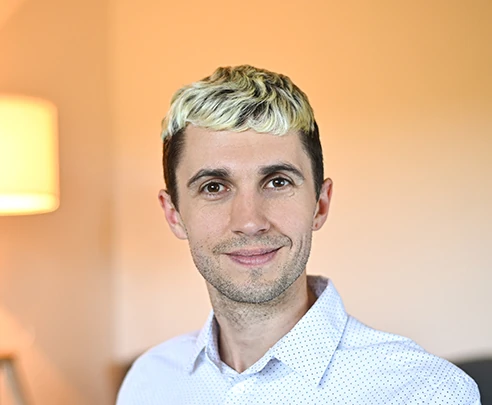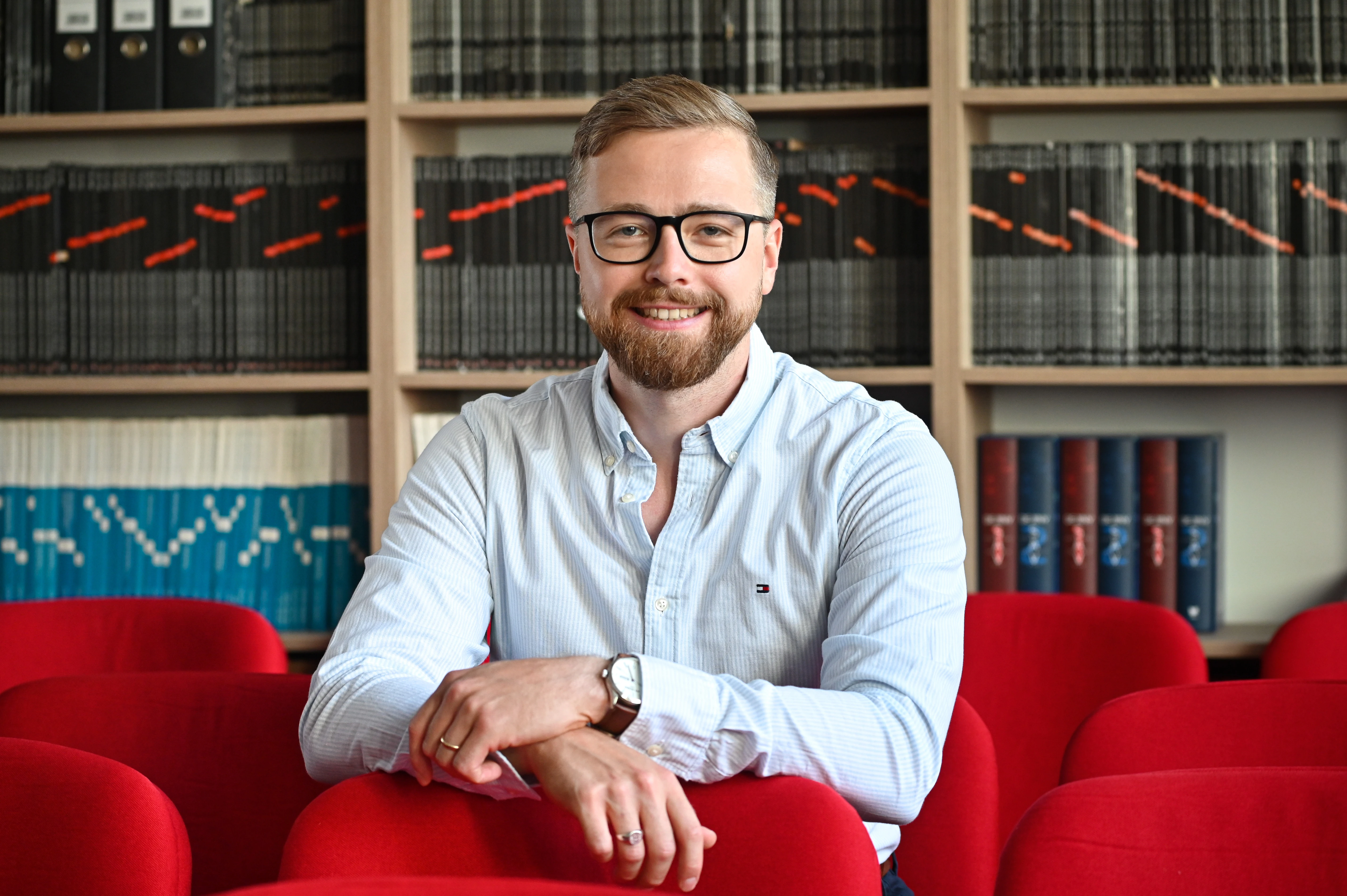
From an early age, he wanted to understand how televisions and computers worked, and he was fascinated by great scientists such as Newton and Einstein. His natural curiosity and desire to understand the world around him gradually led him to mathematics, physics, and a career in research. Today, Ing. Mgr. Marián Janík, PhD, works at the Institute of Electrical Engineering of the Slovak Academy of Sciences, where he develops technologies for quantum computers. His research focuses primarily on quantum dots – nanoscale devices capable of confining and controlling a single electron.
He describes quantum dots as advanced descendants of the transistor, the fundamental building block of modern electronics. While a transistor controls the flow of vast numbers of electrons, a quantum dot enables working with individual electrons and observing their quantum properties. Phenomena emerge at this scale that could form the basis of a new generation of computing technologies.
“A processor is only as strong as its weakest link. The aim of my research is therefore to better understand the physical processes taking place in quantum systems and use that knowledge to develop scalable quantum processors. In the future, these could help solve problems beyond the reach of today’s computers, from developing new medicines and materials to optimising transport and logistics or enabling secure communication,” he says.
During his doctoral studies, he worked mainly on experiments. At the Institute of Science and Technology Austria, known as ISTA, he constructed devices, took measurements, and analysed how the devices behaved. Since returning to Slovakia, he has focused more on modelling and numerical computer simulations. His work also includes developing software that could help scientists design and optimise large quantum chips for quantum computers.
During his PhD, Marián Janík achieved two world records and published his results in prestigious scientific journals. Above this, he prizes the experience he gained over six years at ISTA. “It’s an achievement that stands out on my CV, but what I learned along the way matters much more to me,” he explains.
In Slovakia, he had been used to being among the best students. At a leading international research institute, however, he found himself surrounded by people from all over the world who were just as talented and ambitious. “It brought me down a peg or two,” he admits.
The experience taught him humility and perseverance. For the first four years, his research did not go well, and he felt under considerable pressure. That was when he discovered what it means to do science – you have to keep going even when you haven’t seen any results in years. The support of his supervisor and the overall experience helped him keep going. At his institute abroad, researchers had access to psychological support, coaching, sports facilities, and places to relax, all with the aim to give them the conditions they needed to focus on what mattered most.
ISTA also gave Marián Janík the experience of an exceptionally international environment, which proved transformative for him. He worked alongside people from dozens of countries, and meeting them showed him that different cultures often share values such as honesty, hard work, and an enduring curiosity.
After completing his PhD, he had the opportunity to stay abroad and continue his career at leading research institutes. Even so, he decided to return to Slovakia. The idea of coming home had been taking shape before he left. “I wanted to experience it for myself and then bring what I had learned back home,” he explains.
He believes Slovakia has capable people but struggles with a lack of resources and infrastructure, as well as processes that make research more difficult, though he does not consider funding the only barrier. People, the way teams and institutes are led, and the wider research culture all play a major role in what can be achieved even with limited means. His return was also motivated by his family, friends, and community. He considers Slovakia his home and feels a certain responsibility towards it.
He puts his experience to use both in his own research and in the scientific world around him. He supervises students, teaches at the Slovak University of Technology in Bratislava, and, together with colleagues, organises discussions on new scientific papers known as journal clubs.
He sees the shortage of young people as one of the greatest challenges facing Slovak science. Abroad, he saw much larger teams of doctoral students and early career researchers working alongside each senior scientist. In Slovakia, the situation is often the reverse.
Marián Janík was pleasantly surprised to find that he was not the only scientist to return to Slovakia. “I thought there would be only a handful of us. But in the year and a half I’ve spent in Slovak research, I’ve been hearing more and more stories like mine. More experienced scientists are returning too, and setting up their own research groups here. I find that very inspiring.” He was also surprised that scientists still rank relatively highly in surveys of public trust in Slovakia. “We live in a time of crisis of trust between people, so I was all the more happy to learn that people still see scientists as people who know what they’re talking about and say only what they know. That is what makes someone trustworthy,” he adds.
His ambition in science goes beyond achievements, publications, and grants – he wants to build his own research group, where young scientists could develop both professionally and personally. In doing so, he hopes to help improve the research culture and bring some of the world of science he experienced abroad back to Slovakia. Above all, he wants to keep enjoying science. “To remain a curious child, a lifelong student; to wonder and to play. A scientist is someone who is playful for a living and never loses their spirit. Because a happy scientist is a productive scientist,” he believes. He is also re-learning taking play seriously by currently being on parental leave with his young daughters.
He also enjoys classical philosophy. While at university, he completed a two-year academic programme at the Collegium of Anton Neuwirth, where he read some of the great works of philosophy. He sees philosophy as a completely different way of thinking that enriches him and helps him see the world from another perspective.