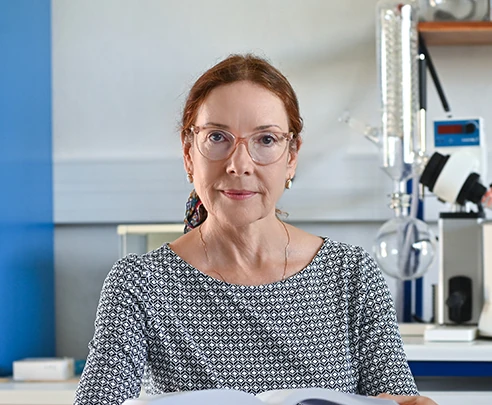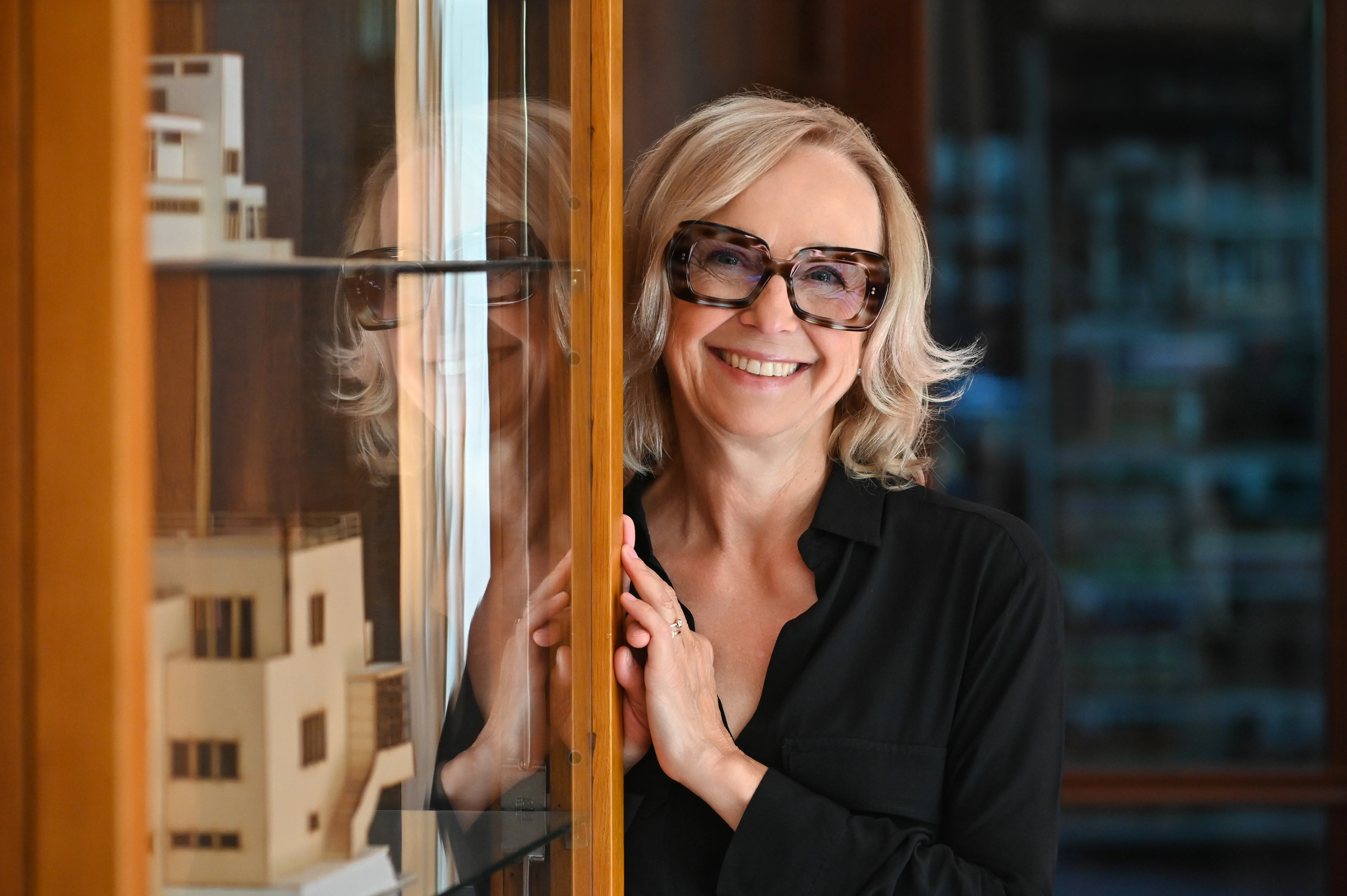
Professor Dr. Ing. arch. Henrieta Moravčíková is a leading expert on the history of 20th- and 21st-century architecture. She works at the Faculty of Architecture and Design of the Slovak University of Technology in Bratislava and heads the Department of Architecture at the Institute of History of the Slovak Academy of Sciences. Her research focuses on modern architecture, urban planning, and the preservation of architectural heritage. She is interested in the layers of time, social processes, ideologies, and stories embedded in buildings and cities. Even as a student, she was drawn more to history and analytical work than to designing buildings. The decisive impulse came after graduation, when she joined the Slovak Academy of Sciences. “I was excited by the explorer atmosphere, by questioning supposedly eternal truths, and looking for new ways to understand the relationship between society, architecture, and urban planning.”
She considers the book Architektúra Slovenska v 20. storočí (20th Century Architecture in Slovakia) that she wrote with Matúš Dulla to be her first major work in which she felt she had found her calling. Even then, they were thinking about how to make architectural history accessible to people outside the profession. “I try to present the results of our research in an essayistic style so they are enjoyable to read. We always joke that we are a bit like writers.” The same interest in the city inspired two more books about the city’s planning and its housing estates in the history. She chairs the Slovak working party of DOCOMOMO, an international organisation devoted to documenting and protecting modern architecture. The organisation’s register of significant buildings also provided the basis for her distinctive monography on Slovak architecture.
She is particularly interested in the work of Friedrich Weinwurm and the broader study of architects from ethnic minorities in interwar Czechoslovakia. She also researches the lives of architects who emigrated to Great Britain. She dedicated the exhibition Emancipované: prvá generácia architektiek na Slovensku (Emancipated: The First Generation of Women Architects in Slovakia) to the position of women in the field. Doctoral research in her team now builds on that work.
Moravčíková believes knowledge should not remain confined to academia. “I consider it extremely important for us scientists to be able to step out of our ivory towers and comfort zones.” This is one of the reasons why she takes part in public debates over the preservation of 20th-century architecture. She considers the demolition of Istropolis in Bratislava, Slovakia’s largest cultural and social venue, as a major defeat. But for her, a story doesn’t have to end with the defeat. “Every defeat teaches you something about strategy.” More than ten thousand people supported a petition to preserve Istropolis, but the building could not be saved. Years of effort brought the opposite result for the Prior department store and Hotel Kyjev complex on Kamenné Square in Bratislava – they are now protected under built heritage conservation. “All of this is a marathon,” the respected expert observes.
Yet when she takes a public stand, she does not claim to have the one right answer. “We do not own the truth. We bring our knowledge into the public discussion, but we cannot claim that our perspective is the only one.” For her, the will to listen to the other side matters just as much as the responsibility towards public estate.
She teaches the history of architecture, the history of urban planning, and current trends in architecture. Critical thinking is central to all three subjects. Meeting a client’s requirements is not enough – architects must also consider the effects of their work on people who live near a building or pass by it. She explains to her students that architecture is more than a trade or a collection of beautiful buildings. “Behind architecture, there are social processes, politics, ideologies, and money.” In her view, architecture is political – not in a party-political sense, but because shaping public spaces also shapes society. “Every morning when we open our eyes, we are confronted with architecture. Even at night, when our eyes are closed.”
She does not see herself as a professor whose authority rests on her title. When doctoral students pointed out that the existing teaching approach was not working, she worked with them to shorten the lectures and make more room for discussion and group work. “Students are absolutely brilliant at field and archival research. And they are delighted when they discover something.” They help her find buildings beyond the main areas, in places they know well. Contact with younger generations matters to her, too. “They hold up an enormous mirror to us as well – showing us what we do and how we see the world.” Feedback from doctoral students can even prompt changes to research plans. Future architects need to understand the environment they will work in, know the intentions of earlier generations, and recognise what is worth building upon and what calls for a different approach.
Her team recently completed a project on post-war modernist architecture in Slovakia. They mapped approximately 1,200 works and visited more than 500 selected buildings in person to assess their condition. The findings are intended to help guide the conservation and sensitive restoration of public buildings. The team is preparing a new book on post-war modernism in Slovakia based on the research. “When a building is genuinely good, well conceived, and works well with its surroundings, it can come back to life, even if it has had periods when it seemed lifeless. And there is tremendous hope in that,” Professor Moravčíková says, underscoring her conviction.
She is “unashamedly enthusiastic” about her research projects which she also admits in a book-length interview with Patrik Garaj. She sees herself as a seeker of truth who cannot remain silent: “I cannot stand injustice, lies, or wrongdoing. That is also why I like standing on the barricades.” She wants to defend the truth, not claim ownership of it. In her husband, the architect Peter Moravčík, she has a partner for never-ending conversations about the profession that has captivated them both.
She has been enjoying running for almost twenty years, preferably with her dog in the woods. While at work she cares about people listening to one another, on a run she seeks moments when no one else is around. “Running is meditation for me.” Ultimately, her work is not unlike a marathon – some results take years to arrive.