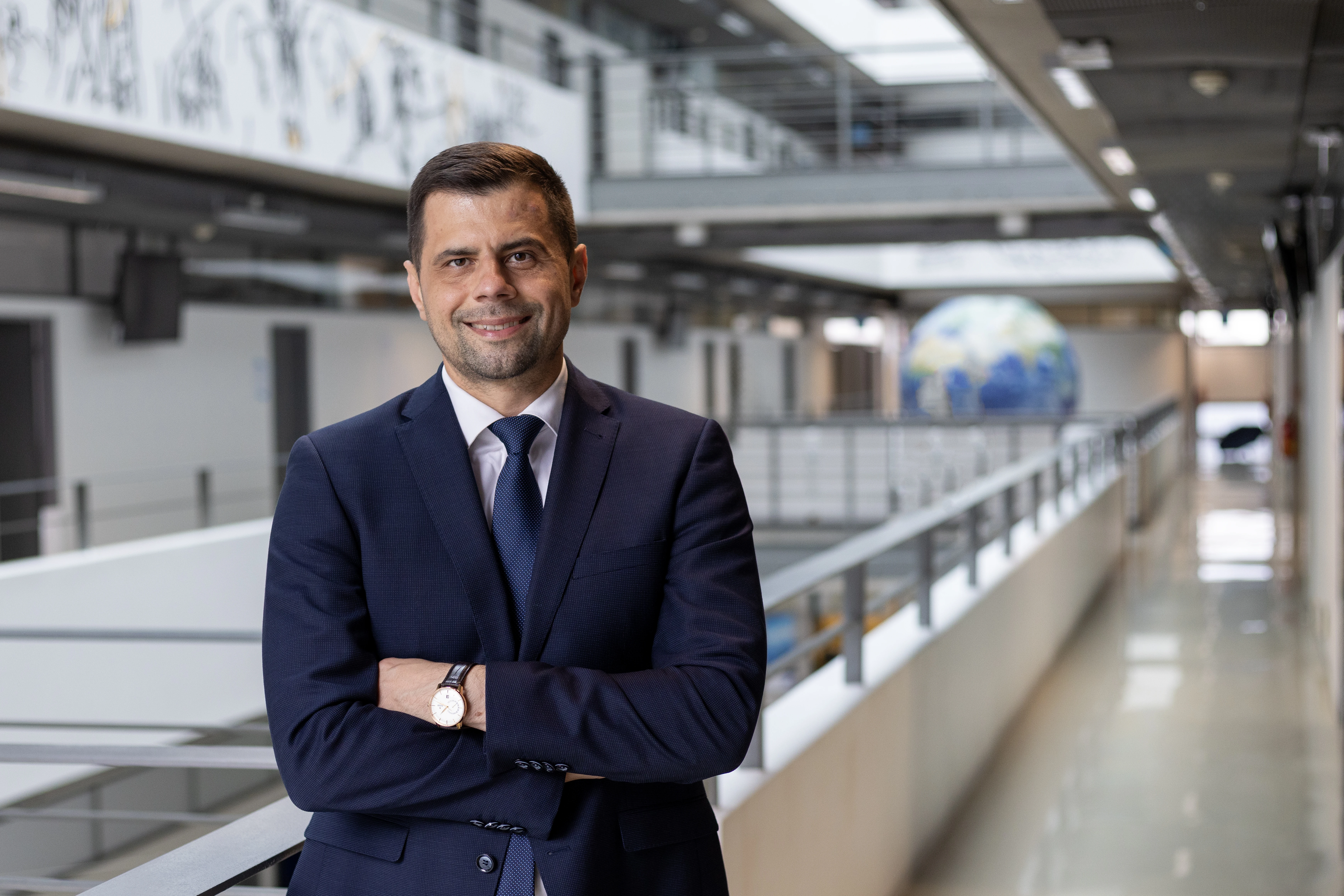
Professor Ing. Juraj Gazda, PhD, works at the Faculty of Electrical Engineering and Informatics at the Technical University of Košice (TUKE). As Vice-Rector for Innovation and Technology Transfer, he also works on bridging university research and real-world applications. At the Department of Computers and Informatics, he leads the Intelligent Information Systems Lab (IISLab), a research laboratory focusing on AI, robotics, communication networks, medical applications, and quantum technologies.
Professor Gazda grew up around teachers. His father, a professor of economics, played an important role in guiding his choice of university. During his studies, he completed research fellowships at Delft University of Technology, Ramon Llull University in Barcelona, and Hamburg University of Technology. Meeting scientists at these institutions sparked “a strong interest in science, research, and education”. He began his career working on wireless communication networks before shifting his focus to AI. “The progress of AI is so profound that I see many parallels with the Industrial Revolution. It will have a major impact on the labour market, and people will need to continuously update their knowledge and adapt to new conditions,” he says.
One of his team’s main research areas is the use of AI in autonomous systems, ranging from robotics and smart industry to autonomous vehicles. In the MetaMobility project, they study digital twins of autonomous mobility and explore how AI can make these systems safer and more efficient. The team’s research also extends into healthcare, particularly medical imaging and more accurate diagnostics. “We are also exploring how language models can reduce some of the administrative burden on doctors,” Professor Gazda explains.
He wants to bring the results of this research into businesses and hospitals across the region. “For me, this is the be-all and end-all – doing high-quality research that we can subsequently translate into practice.” He realistically acknowledges that his team is unlikely to revolutionise global AI research. Instead, he sees even greater value in the tangible impact the lab can have locally. “We can expect new economic growth from an innovation-driven economy – small and medium-sized businesses capable of extremely quick innovation. And for that, they need strong universities.” His ambition is for TUKE to transfer new knowledge into practice faster and on a larger scale.
He sets equally high standards for education. In his teaching, he sees how assignments completed with the help of AI can appear flawless, only for an exam to reveal that the student may not genuinely understand the subject. “If you want to understand AI, you first need to understand the mathematics behind it.” In his view, knowing how to use a ready-made tool is not enough. Students need to be able to analyse complex problems and understand how AI fundamentally works.
He considers the ability to understand and formulate a problem – and to take responsibility for the result – essential. “Today, students often lack one basic skill – understanding and formulating a problem and proposing a solution.” Even if the calculation itself is performed by a model or a supercomputer, the student must be able to verify the result. “They need to be able to say: This is the result, and I stand behind it.”
He therefore does not see the future of higher education as abandoning foundational knowledge. Mathematics, physical principles, and analytical thinking will remain essential even in a world where technology takes over a large share of routine tasks. “We need to be prepared to learn quickly and remain flexible,” he says of the near future. At TUKE, he is therefore also involved in developing new programmes focused on quantum computing technologies and health informatics.
Gazda works most closely with his PhD students, from whom he expects internationally competitive research and experience at institutions abroad. Some have completed parts of their studies in the United States or at King’s College London. In his everyday work, however, he rejects formal distance and rigid hierarchy. “I’m not some strict authority figure. I’m one of them. We have a friendly relationship.” This collegial approach does not mean lowering expectations. “The only way to succeed is to be fully committed to the work. Doing things superficially simply does not pay off.”
Even more important than research results, however, is the character of the people he mentors. “My PhD students have very strong moral and social values. That may be even more important than the results themselves.” Several of his doctoral students have remained in academia and are now teaching the next generation of scientists. This is why he considers it essential for future university teachers to “have a strong moral compass and not look for shortcuts”.
He expects a similar level of commitment from himself. His work is also his hobby, and he spends much of his free time continuing to learn about AI. His wife sees this dedication as a reflection of his strong determination. He finds respite in his family and in sport – running, going to the gym, and playing tennis. He acknowledges that in the past he did not always manage the boundary between work and private life well. “My family truly fulfils me. Without them, I would never be where I am today – especially without my wife and my children.”