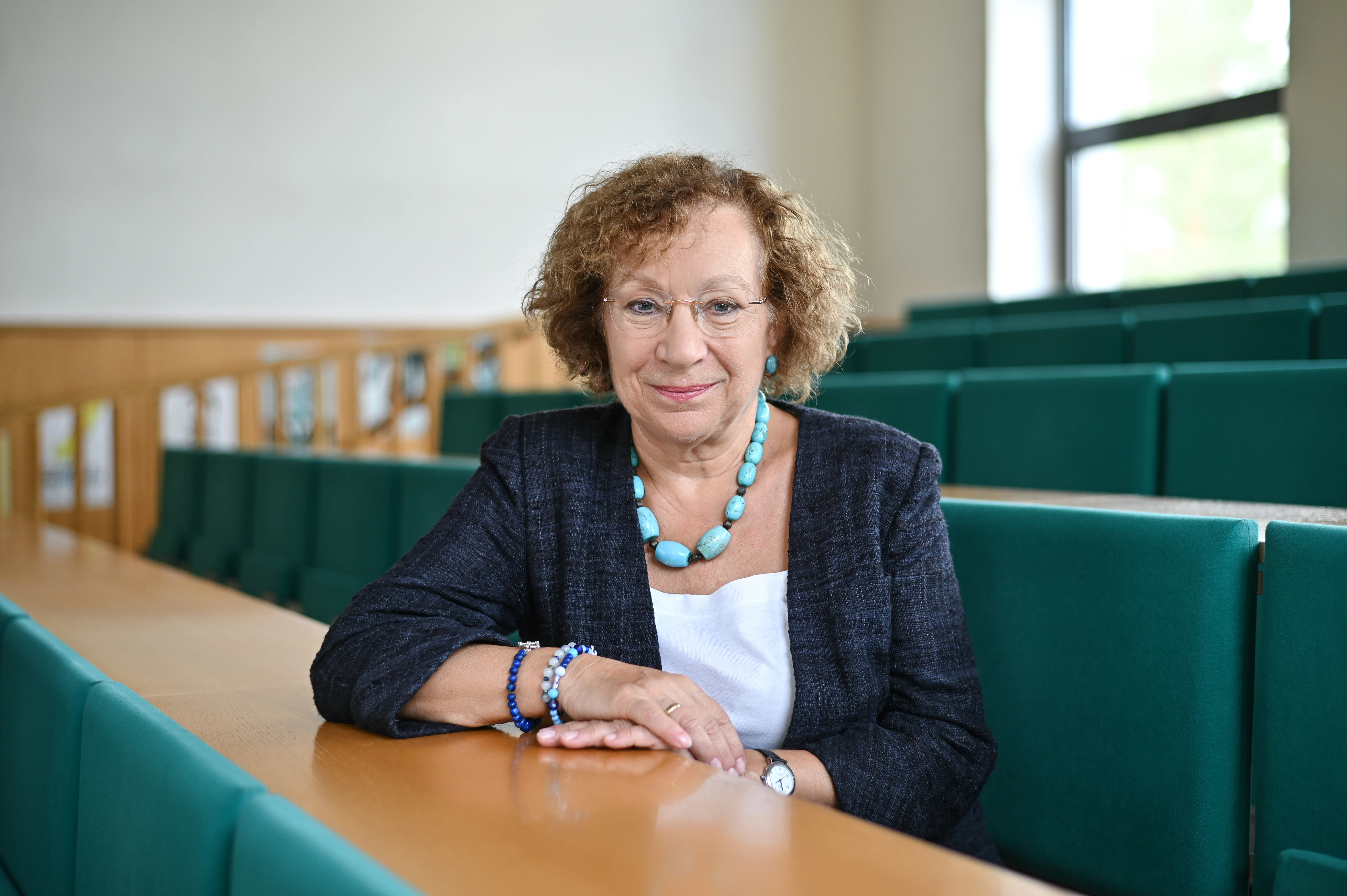
Associate Professor Oľga Gyárfášová, PhD, is a respected sociologist and political scientist teaching at the Institute of European Studies and International Relations at the Faculty of Social and Economic Sciences, Comenius University Bratislava, which she headed from 2015 to 2020. Her long-standing research interests include electoral behaviour, political culture and public opinion, societal polarisation, the position of women in public life, and citizens’ attitudes towards the European Union. “Our strength lies in our ability to explain why things happened and what their deeper causes are.” She describes the European Election Study (EES) as a project particularly close to her heart. She helped bring Slovakia into the study for its first European Parliament elections in 2004 and today serves as the national coordinator of both the EES and the Comparative Study of Electoral Systems (CSES).
After 1989, she was part of a generation of sociologists who established independent public opinion research in Slovakia, initially at university and later through a commercial research agency. In 1997, she co-founded the Institute for Public Affairs, an independent analytical think tank. The institute connected expert research with public debate and, in Gyárfášová’s words, “held up a mirror to society” – explaining in accessible terms how society was changing and navigating democratic transformation, integration into the EU and NATO, and populism and extremism. Later, as an adviser to President Zuzana Čaputová on social issues and public opinion, she also gained first-hand experience of the world of high-level politics.
She considers independent public opinion research a natural and necessary part of a democratic society. At the same time, she emphasises its methodological limitations and the importance of data literacy. “Even if you do not work directly in research, you need to understand it. You need to be a qualified and informed consumer who knows how to work with research findings and data.” She therefore teaches students to distinguish representative research from informal polls, understand the degree of uncertainty in data, and avoid drawing major conclusions from differences unsupported in numbers.
She has recently been studying volatility in electoral behaviour, positive and negative party identification, the personalisation of politics, and affective polarisation. She also examined the latter in the context of Slovakia’s 2024 presidential election in a standalone study. Her academic ambition is to see the establishment of an institutionally anchored, sustainable programme of democracy research that would regularly examine the broader context of electoral decision-making and the functioning of democracy.
Another long-standing focus of her work is the political representation of women and the mechanisms that shape their presence in public institutions. Her commitment to making women’s experiences more visible also led her to write the book Ako sme žili v rokoch normalizácie. Rozhovory s aktérkami spoločenstva vzdoru (How We Lived During the Normalisation Era: Interviews with Women from a Community of Resistance). She wrote it not only as a sociologist but also as one of the participants herself, having been part of Bratislava’s alternative cultural milieu. The book also opened up another area of her current research, the politics of memory – how societies decide who and what is worth remembering and what, for various reasons, is pushed out of collective memory.
Gyárfášová began teaching at university after years of research and analytical work, and it is precisely this experience that she now passes on to her students. “I don’t teach ‘what’ in the sense of data and basic knowledge – all of that is now quickly and easily accessible. Instead, I try to teach ‘how’ – how to work with information, how to approach a problem, and how to navigate the sheer amount of information available.” She encourages discussion and argumentation and teaches students to recognise that every decision has consequences. Alongside analytical thinking, she seeks to foster openness, respect for difference, and democratic values. Some of her greatest professional satisfaction comes from former students telling her that she pointed them in the right direction or inspired them.
Sociology and public affairs are also present in the next generation of her family. Her daughter, Tina Gažovičová, studied sociology, earned a PhD in public policy, and is now a member of the National Council of the Slovak Republic, where she focuses primarily on education. Oľga Gyárfášová also spends a great deal of time with her four grandchildren. “Watching these children grow, become wiser, and develop their own personalities brings me immense joy.” She finds both relaxation and inspiration in cinema, visual art, and, above all, books – and for more than twenty years, she has been meeting regularly with friends as part of a book club.
Sometimes she wonders whether it might be easier to study rocks or other unchanging objects – something solid and predictable. Yet it is precisely the opposite that draws her to the social sciences. “The social reality is extraordinarily fluid. It is an open system – exciting, fascinating, and always capable of surprising us.”