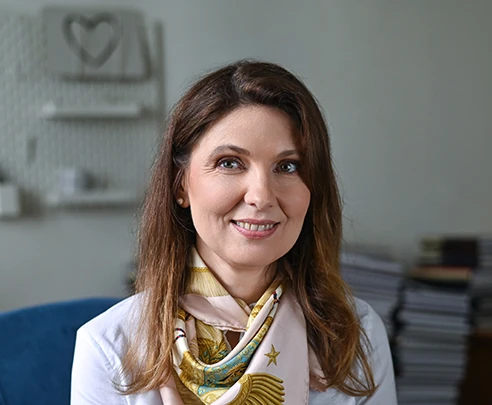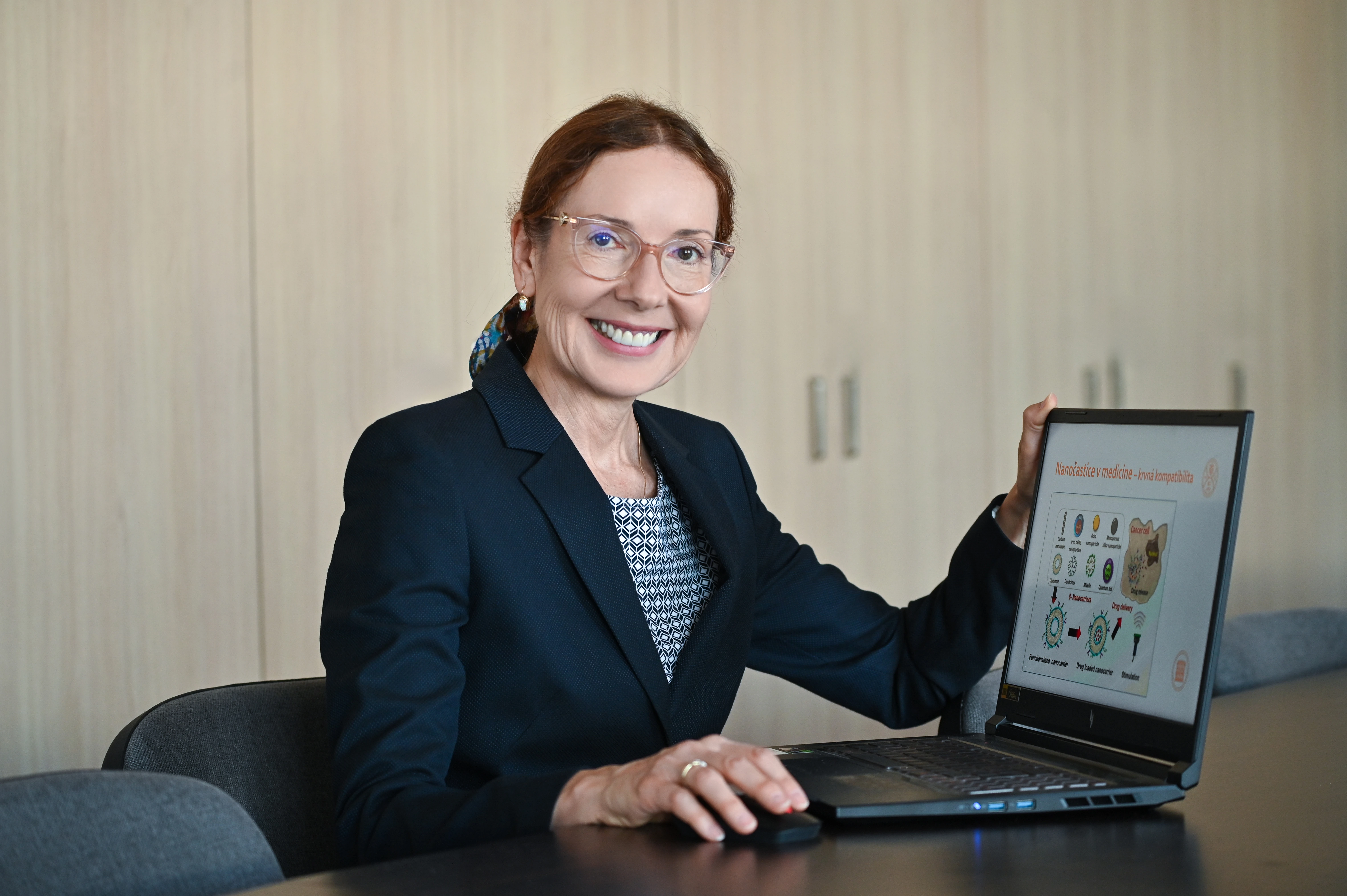
Professor Iveta Waczulíková, PhD, is a professor of physics at the Faculty of Mathematics, Physics and Informatics, Comenius University Bratislava. Her research focuses on the biophysical properties of living systems in health and disease, particularly in diabetes, cardiovascular diseases, and cancer, as well as on assessing the physical properties and blood compatibility of nanoparticles with potential medical applications.
She is also the academic lead of the unique interdisciplinary Biomedical Physics programme, which bridges physics and medicine. Its students learn to process the results of biophysical measurements, interpret their medical significance in relation to processes in the human body, and develop the skills needed to communicate professionally with doctors in clinical practice. She explains the essence of the discipline simply: “We are biosignal hunters.” Biomedical physicists design and use methods to extract information from the body about the processes taking place within it. A signal might be a change in temperature, pressure, or blood viscosity. By comparing measured values with what we would expect in a healthy body, it is possible to detect when something is beginning to change.
At the start of her scientific career, Waczulíková focused on diabetes research. After studying biophysics and chemical physics, she applied for postgraduate study at the Faculty of Medicine of Comenius University. During the selection process, Professor Jozef Čársky introduced her to research into substances with potential antidiabetic effects and asked what she could contribute as a biophysicist. “I based my answer on the methods I had used in my diploma thesis under Professor Libuša Šikurová. Suddenly it occurred to me that perhaps this was a field where I could be better than average.” She therefore advises students to look for a field in which they can make use of their abilities, see meaning in their work, and be useful to others.
Today, her research focuses primarily on how various factors affect cellular energy metabolism, blood properties, and the function of the vascular endothelium – the inner lining of blood vessels. Disruptions to these processes contribute to complications in cardiovascular and metabolic diseases, as well as to some of the consequences of long COVID. “I consider our efforts to understand the mechanisms that lead to adaptive or damaging changes in cellular energy metabolism and in the function of the blood and vascular endothelium to be the most important area of my research.” A better understanding of these mechanisms could help identify biomarkers capable of detecting emerging damage before it becomes clinically apparent. She also studies adaptive mechanisms in cardiac mitochondria and their role in protecting the heart.
She also researches nanoparticles for medical applications. These can serve as drug carriers – helping to deliver medicines directly to a target such as a tumour. Her team investigates how nanoparticles affect blood viscosity, flow properties, and coagulation, and at what doses they might begin to pose a risk. “We look at how well a nanoparticle gets along with its environment. We are searching for a safe dose range under laboratory conditions.” This research can help optimise the chemical structure of nanoparticles and reduce the risk of adverse effects.
Waczulíková has taught biostatistics and research methodology for many years and is a co-author of the textbook Introductory Biostatistics. She also helps doctors analyse clinical data. “Data do not tell the truth by themselves. Their value depends on the quality of the experiment or observation they come from. A trustworthy result is one that we can explain, verify, and reproduce under similar conditions.” She teaches students to distinguish statistical significance from clinical relevance. She also sees potential in machine learning and clinical decision-support systems. An algorithm may calculate a result and suggest a course of treatment, but it cannot take responsibility for the decision. “Someone still has to put warrant that decision.”
She involves students in research projects and connects their thesis topics with real-world needs. She teaches them to design their own approaches and not to be afraid of uncertainty. “Instead of waiting for the ‘right’ answer, you need to ask your own questions, challenge assumptions, and openly discuss results and their interpretation. At that point, you are no longer thinking like a student trying to complete an assignment, but like a scientist trying to understand a problem.” In her view, making mistakes is part of research – only when we admit that we do not understand something can we begin to investigate it seriously. Equally important is the ability to look for alternative explanations and to notice evidence that does not support the original expectation.
She carries this way of thinking into her personal life as well. “I try not to react immediately and to consider possible alternative explanations, so that the emotional side does not dominate,” she says. “It has given me greater humility.” She devotes much of her time to her family and caring for her parents, and takes great joy in her children and granddaughters. She is also fond of bees, her vineyard, nature, and art. She herself connects family life with her approach to students: “The way I work with students reflects how we try to live together at home.” She refers to them as her “other children” and is open and honest with them about her views and attitudes.
When asked to name an idea that particularly resonates with her, she chooses a line from Success by the American writer Bessie Anderson Stanley: “He has achieved success who has left the world better than he found it.”